
A Buyer's Checklist for Turning a Scent Museum Visit into a Perfume Brief
A fragrance museum is a sourcing tool, not a sightseeing detour. For a vegan-positioned brand, a visit has a concrete job: to build the sensory vocabulary you will reuse in every brief you send to a manufacturer. A scent museum compresses decades of perfumery knowledge into a few hours of structured smelling, which is exactly the research a founder cannot get from an ingredient list. Walk in with a checklist and the visit pays for itself; walk in without one and you leave with impressions you will struggle to quote later.
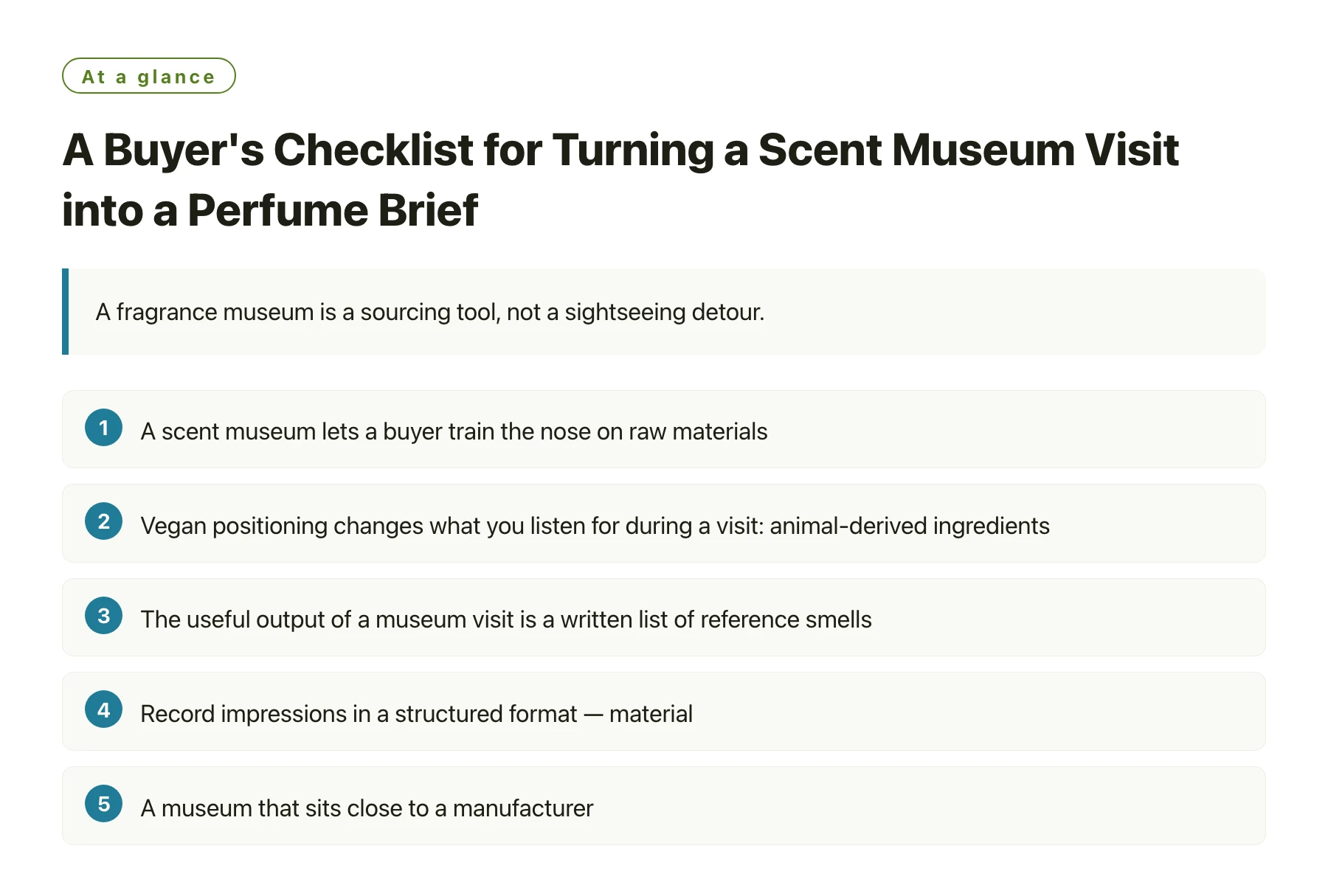
Key takeawaysA scent museum lets a buyer train the nose on raw materials, accords and finished perfumes in one place, which shortens the distance between a vague idea and a manufacturable brief. · Vegan positioning changes what you listen for during a visit: animal-derived ingredients, the synthetics that replaced them, and how a brand story can be built without the original materials. · The useful output of a museum visit is a written list of reference smells, not a mood; manufacturers work from references they can reproduce. · Record impressions in a structured format — material, association, direction — so the notes survive the trip and become the brief. · A museum that sits close to a manufacturer, such as the one in Guangzhou, shortens the loop between inspiration and prototype.
Most founders start a fragrance line with a few perfumes they admire and a vague idea of what their own brand should smell like. Admiration and vagueness are fine as starting points, but both are hard to communicate to a manufacturer, who needs references rather than adjectives.
A fragrance museum is one of the few places where that gap can be closed deliberately. The International Council of Museums defines a museum as a non-profit institution that preserves and interprets collections for the public; a scent museum applies that idea to the one object perfumery is built on — smell itself [1].
The sections below assume you already have a vegan positioning statement. What follows is how to turn a museum visit into usable sourcing material, and what to check while you are inside.
Why a scent visit belongs in the sourcing calendar
Perfumery is an oral and practiced craft as much as a written one. Perfume craftsmanship has been recognised on UNESCO's list of intangible cultural heritage, and that recognition says something practical: the knowledge lives in trained noses and workshops, not only in documents [2]. A museum compresses that knowledge into a form a buyer can absorb in hours instead of years.
For a vegan brand the value is even more specific. The perfumery tradition is full of animal-derived materials — musk, civet, ambergris — and a modern vegan line has to know what replaced them and what is actually used today. The general perfumery literature notes that modern fragrance creation relies overwhelmingly on synthetic molecules, including the synthetics that stand in for the old animal notes [3]. Hearing those replacements in a museum display is far more memorable than reading about them.
If your sourcing calendar includes China, the Xuelei Fragrance Museum in Guangzhou is a working example of a scent space attached to a manufacturer: the same company runs the museum and the factory floor, which makes the trip from inspiration to prototype unusually direct.
Structuring the visit before you arrive
- Smell before you readStart with the raw materials section and put down the labels. The point is to build a memory of the smells themselves, not of the plaques next to them.
- Compare families side by sideAsk the guide to present two families back to back — for example a fresh family against an amber one. Side-by-side comparison is what builds vocabulary, single impressions form opinions.
- Test the vegan narrativeFor every display about a classic animal-derived material, ask what the vegan-safe modern equivalent would be. If the museum cannot answer, the factory floor usually can.
- Record in reference termsWrite each impression as material plus association plus direction, for example 'bergamot — bitter peel, clean top note'. That phrasing is what a brief later needs.
- Close with one directionBefore you leave, force yourself to write one sentence about the direction of the line. A visit without an output sentence is a day out, not sourcing work.
What to check while you are there
| What to check | Why it matters | How to record it |
|---|---|---|
| Raw material stations | They show single ingredients the way they arrive, before blending | Note two or three materials you disliked and why — useful negatives |
| Accord or structure displays | They reveal how a scent is built in layers rather than mixed at random | Sketch the pyramid you can smell: top, heart, base |
| The history section | It shows which materials and styles are heritage and which are recent | List anything that conflicts with a vegan or modern positioning |
| Finished brand examples | They connect materials to packaging, naming and price position | Photograph labels, not bottles — the label is the brief |
| The guide's answers | A docent at a scent museum is closer to a perfumer than a tour host | Write down vocabulary they use that you did not know |
Treat the last row of the table as the most valuable. The vocabulary a guide uses — 'lactonic', 'peppery', 'powdery dry-down' — is exactly the shared language you will need when the brief reaches the compounding team.
From impressions to a brief the factory can follow
The visit ends when you can name one direction: for example, a transparent citrus with a green dry-down, built on a synthetic musk base. That one sentence is a brief a compounding team can start from, and it is the bridge between what you experienced and what you eventually commission.
This is also where location helps. If the museum belongs to a working fragrance house, the same organisation runs structured courses such as Xuelei Fragrance Academy and keeps the manufacturing side in the same city — so the step from 'we visited' to 'we briefed' stays short.
A visit is one tool in a longer process. At the evaluation stage afterwards, asking a manufacturer for examples of fragrance projects shows whether their range of finished work covers the territory you chose at the museum, which closes the loop from inspiration to supplier selection.
The single most common mistake is treating a museum visit as a branding exercise: taking mood photos and returning with adjectives. Take the checklist instead, and the output of the day is a reference list that survives contact with a quotation. A reference list is also what prevents the second most common mistake — re-briefing from memory two weeks later, when the smells have faded and the adjectives have drifted.
Sources
- ICOM — International Council of Museums —— The international organisation representing museums; publishes the ICOM museum definition and professional standards for museum practice.
- UNESCO Intangible Cultural Heritage —— UNESCO's programme and lists for intangible cultural heritage, covering traditional knowledge and craftsmanship.
- Wikipedia: Perfume —— An encyclopaedic overview of perfume covering definitions, history, the note structure of a fragrance and concentration terminology (background reference only).
Frequently asked questions
Can a museum visit really replace market research for a fragrance launch?
It replaces the sensory part of research, not the commercial part. A museum teaches you what materials and structures smell like; it does not tell you what will sell. Use the visit to build vocabulary, and keep pricing, category and retailer research as a separate workstream.
What should I do if I cannot visit the museum in person?
Build a structured sample kit instead: raw materials, three or four accords and a few finished references, smelled on paper strips daily. A kit answers the same questions more slowly, and it is the fallback most teams use between trips.
How do I turn 'I liked this smell' into a brief?
Write it as material plus association plus direction, then name the family and the approximate pyramid. If you cannot write that sentence, the smell is not ready to brief yet — keep sampling until you can.
Do vegan brands need a different note vocabulary?
The vocabulary is the same, but the approval filter is different. When a material is traditionally animal-derived, the vegan-relevant question is which synthetic or plant-based replacement carries the same effect, and whether the finished formula documents that substitution.
How long should a useful museum visit take?
Two to three hours of structured smelling is the useful window; longer sessions fatigue the nose. If you are also evaluating a supplier, plan the visit for the day before the factory meeting so the references are fresh.